

Weekend warm up for RVA
And a wetter pattern follows to close the month

5pm Wednesday, March 26, 2025
Some nice weather is ahead in Richmond before we go into a wetter pattern next week. For the short term:
Thursday: Sunny and around 60.
Friday: Sun and afternoon clouds, upper 60s.
And warmer this weekend:
Saturday: Sun and clouds, breezy, and much warmer, upper 70s.
Nothing more than a light jacket is needed on Saturday night, as we stay above 60 most of the night.
Sunday brings sun to start, but then more afternoon clouds with a few showers push through. Right now it looks like later afternoon and/or into the evening for those showers.
The southwest wind will persist from Saturday, so it will feel a little but humid as temperatures return to the 70s before the showers move through.
After some brief clearing Monday morning and reaching the low 70s, another spell of rain is ahead Monday evening and into Monday night.
Beyond Monday, we see 2-3 more chances for some soaking rain through the first week of April.
There will be some cooler spells, but no sign of a freeze through April 10.

Weather balloons - what do they do?
Below is a post from a meteorologist colleague and friend in Houston, Matt Lanza. This is from his excellent newsletter, The Eyewall. You can find his full post at this link, but I wanted to showcase some of the important points in light of recent events.
His words follow with only minor edits by me for clarity.
Due to staffing constraints, as a result of recent budget cuts and retirements, the National Weather Service has announced a series of suspensions involving weather balloon launches in the last four weeks. But what does that mean for weather forecasting?
In a normal time, weather balloons are launched across the country and around the world twice per day, right about 8 am EDT and 8 pm EDT. As an aside, here’s a primer on everything you need to know about why weather balloons are launched around the world at the same time. It’s a unique collaboration and example of global cooperation in the sciences, something that has endured for decades.
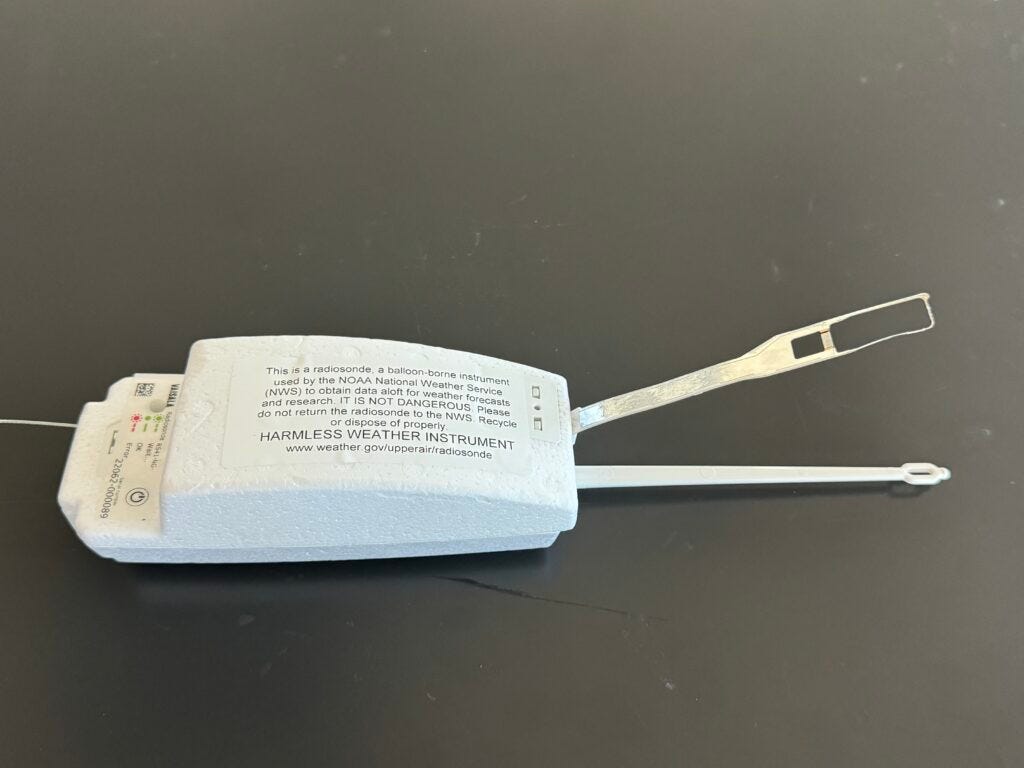
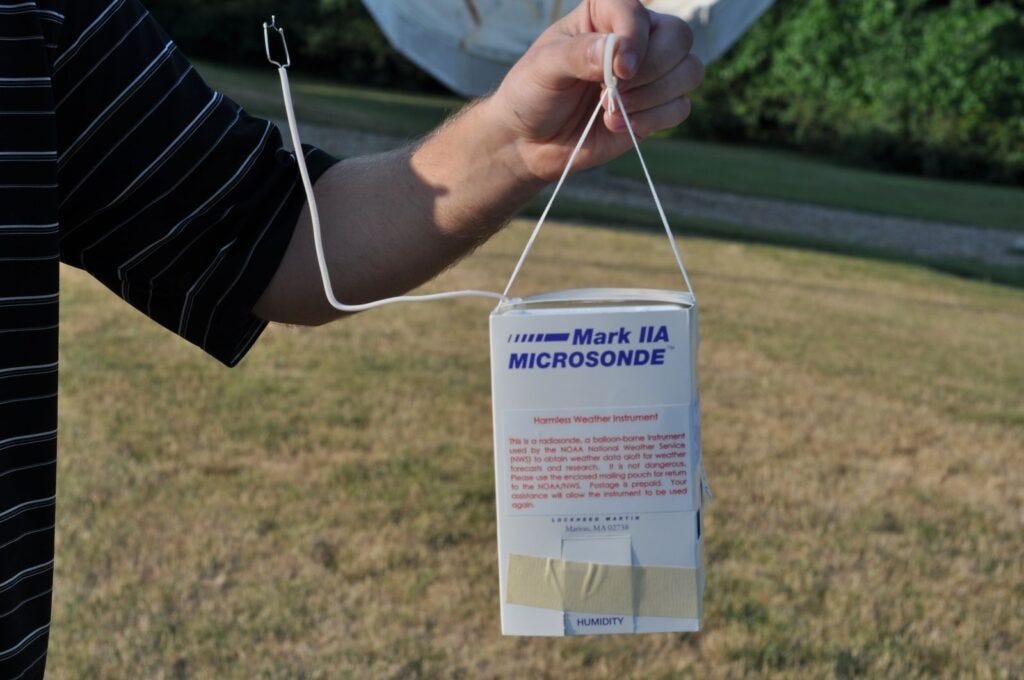
These weather balloons are loaded up with helium, soar into the sky, and get to a height of over 100,000 feet before they pop. Attached to the weather balloon is a tool known as a radiosonde, or sonde for short. This is a weather sensing device that measures temperature, humidity, and air pressure. Wind speed is derived from the GPS transmitting from the sonde.
What goes up must come down, so when the balloon pops, the sonde falls from the sky. A parachute is attached to it, slowing its descent and ensuring no one gets plunked on the head by one.
If you find a one, it should be clearly marked, and you can keep it, let the NWS know you found it, or dispose of it properly.
In some instances, there is a way to mail it back to the NWS (postage and envelope included and prepaid).
What do we do with that data?
In order to run a computer weather model, you need an accurate snapshot of what we call the initial conditions of the atmosphere.
Considering the upper air motions drive how weather systems react down here where we live, this is a huge help in developing the initial conditions to plug into a weather model (also known as a first-guess field).
Plus, observations from radiosondes are important inputs for assessing turbulence that may impact air travel, marine weather, fire weather, and air pollution. Other than some tools on some aircraft that we utilize, the data from these balloon launches is the only real good verification tool we have for understanding how the upper atmosphere is behaving.

Haven’t we lost weather balloon data before?
Yes, but not like this. We are doubling or tripling the number of sites without launches now, many in critical areas upstream of significant weather.
Can’t satellites replace weather balloons?
Kind of. On one hand, modern satellites are capable of incredible observations that can rival weather balloons — at times. And they also cover the globe constantly, which is important. That being said, satellites cannot completely replace the data from balloon launches.
Why? Because the radiosonde data gives us a verification metric for models in a way that satellites cannot. It also helps calibrate satellite data to ensure that what the satellite is seeing is recorded correctly.
But to be quite honest, there have not been a lot of studies that I can find in recent years that assess how the new breed of satellites has (or has not) changed the value of upper air observations.
The NASA GEOS model keeps a record of what data sources are of most impact to model verification with respect to 24 hour forecasts.
Number two on the list of importance? Radiosondes.

What’s the verdict?
In reality, the verdict in all this is to be determined, particularly statistically. Will it make a meaningful statistical difference in model accuracy? Over time, yes probably, but not in ways that most people will notice day to day.
However, based on 20 years of experience and a number of conversations about this with others in the field, there are some very real, very serious concerns beyond statistics. One thing is that the suspended weather balloon launches are occurring in relatively important areas for weather impacts downstream.
A missed weather balloon launch in Omaha or Albany won’t impact the forecast in California. But what if a hurricane is coming? What if a severe weather event (damaging wind, hail, tornado) is expected in 12-24 hours? You’ll definitely see impacts to forecast quality during major, impactful events like those. At the very least, these launch suspensions will increase the noise to signal ratio with respect to forecasts.
In other words, there may be situations where you have a severe weather event expected to kickstart in one place but the lack of knowing the precise location of its genesis — thanks to a suspended balloon launch — will lead to those storms forming 50 miles farther east than expected.
Put another way, losing this data increases the risk profile for more people in terms of knowing about weather, particularly high impact weather.
I don’t want to overstate things: Weather forecasts aren’t going to suddenly and dramatically degrade because we’ve reduced some balloon launches across the country. They will degrade, but the general public probably won’t notice much difference 90 percent of the time.
But that other 10 percent of the time? It’s not that the differences will be gigantic. But the impact of those differences? That could very well be gigantic, put more people in harm’s way, and increase the risk profile for a lot of people.
That’s what this does: It increases the risk profile, it will lead to reduced weather forecast skill scores, and it may lead to an event that surprises a portion of the population that isn’t used to being surprised in the 2020s.
To me, that makes the value of weather balloons very, very significant, and I find these cuts to be extremely troubling.