

Warm weekend for RVA
Plus: Deep trouble for your National Weather Service

4:30pm Wednesday, April 16, 2025
Richmond has reached the time of year when the normal high temperature has crossed the 70-degree threshold — a benchmark that we will stay above until the middle of October. After one more day below that benchmark, warm weather will dominate for the rest of the month.
After a chilly start in the upper 30s on Thursday (be on the lookout for patchy frost), sunny and cool weather holds again on Thursday afternoon.
Friday returns to the upper 70s, then Saturday soars into the 80s.
Sunday likely holds in the 70s.

A weak system will come close to Richmond on Sunday, but it does not look strong enough to produce any rain, meaning the next good chance of significant rain waits until late Monday or Tuesday of next week.
Beyond the end of next week, the weather pattern favors temperatures near or above normal for the final few days of the month.
There is one final caution, as some data indicate a cool spell during the first full week of May. But even that does not suggest a frost or a freeze.
Grotesque cuts to your National Weather Service
“Over the last two months, hundreds of probationary NOAA employees were fired, then un-fired and immediately placed on administrative leave, then fired again. This is not a way to build a sustainable workforce, nor maintain morale within the existing one. The cruelty is the point.”
The quote above is from Robin Tanamchi, an Associate Professor of Atmospheric Science at Purdue University in Indiana who specializes in tornadoes, weather radar, and numerical modeling of features like thunderstorms and tornadoes.

NOAA is the parent organization of the National Weather Service, and hundreds of meteorologists and NWS support staff across the country have been fired, brought back, and fired again due to the recklessness of the new federal administration.
Many former NOAA employees are apprehensive about speaking publicly about it, concerned about retaliation from a new government hostile to the NOAA mission of saving Americans’ lives and property.
Data gathering has already suffered from the decreased number of weather balloons launched, which provide direct measurements of atmospheric conditions through the bottom 10 miles of the atmosphere — where all of our weather effectively occurs.
This data allows the NWS to initialize the computer simulations (aka models) with more accurate data. If the initial data are not good, the forecast will suffer.
According to meteorologist Chris Vagasky, Manager of the Wisconsin high-density weather network called the Wisconet, “The world's example for weather services is being destroyed.”
My colleague Matt Lanza, who runs the Houston weather newsletter, The Eyewall, shared this sobering post from Jami Boettcher at the National Severe Storms Lab in Norman, Oklahoma.
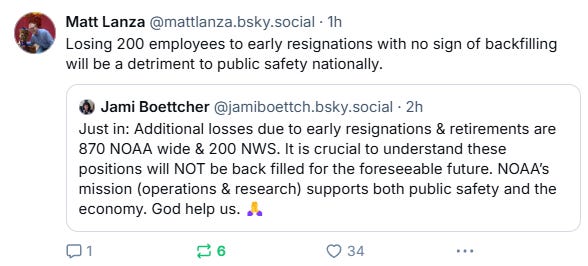
They are not overreacting.
The forecasts you enjoy on your phone are based on data from NOAA with revisions from local NWS offices across the country. The people in those local offices live in their respective communities and are the first to alert the public and emergency managers when truly dangerous weather threatens. The office along US460 in Wakefield serves Richmond and Hampton Roads.
Large storms will not suddenly go unseen, but the ability to catch their finer details — which usually cause the most damage — will gradually degrade, as equipment goes unrepaired, staff is overworked, and the communications infrastructure linking satellites, radar, the the local forecast offices becomes less reliable.
Forecasting will deteriorate to a place it was 40+ years ago. It won’t happen right away, but it will happen. American weather forecasting and research excellence will crumble, allowing Europe and Asia to dominate us on the world stage.
A full summary of the recent news can be found from Lisa Friedman, who covers weather and climate policy and politics for the New York Times.